You open WhatsApp, see the green dot next to a friend’s name, and immediately feel a knot in your stomach. Should you reply now? What if they see you’ve read their message but don’t respond fast enough? WhatsApp online status privacy has become a source of silent stress.
The desire to hide your online presence isn’t just about being antisocial. In this article, you’ll understand not only why people hide but also whether it’s a healthy coping mechanism.
What Is Online Status Anxiety
Online status anxiety describes the stress or discomfort people can experience because their digital activity is visible to others.
It can work in two directions. You may feel anxious when other people are online but not responding to you. Or you may feel anxious because other people can see that you are online.
Both situations can create unnecessary mental pressure.
For example:
> “They were online five minutes ago. Why haven’t they answered?”
Then another thought appears:
> “Maybe they are angry with me.”
Or:
> “I need to answer because they can see that I am online.”
The technology has not actually told you anything about the relationship. You are interpreting a small activity indicator.
This is where digital social anxiety becomes interesting.
The Rise of Digital Social Anxiety: Why Hide Online Status in the First Place
WhatsApp’s visibility features, such as “online” status and read receipts, create psychological pressure to respond. Even without a technical obligation, being seen as active can make users feel compelled to reply immediately.
For introverts, people-pleasers, or those juggling multiple conversations, WhatsApp social anxiety can be crippling.
But there is a catch to WhatsApp’s privacy settings: while you can hide your “last seen” and “online” status from others, doing so means you also won’t be able to see theirs. Many people find this frustrating because it forces a difficult choice. You either have to let others see when you are active, or lose the ability to see when they are available.
That’s where WhatsApp mods come in. Modified versions of the app, such as WhatsApp Blue, WhatsApp Plus, and YoWhatsApp, offer granular control: you can hide your online status from specific contacts while still seeing theirs, freeze your last seen timestamp, or even appear offline while actively reading messages. These features directly address the psychological need for selective visibility—the desire to be seen by some but invisible to others without sacrificing information.
Beyond WhatsApp privacy features: Why WhatsApp Mods Become Attractive
WhatsApp has made strides in privacy. Since 2019, the app introduced disappearing messages, end-to-end encryption for backups, and the ability to silence unknown callers. Yet the online status feature remains a blunt instrument. You can choose between three options: Everyone, My Contacts, or Nobody. There’s no middle ground for “My Contacts Except…” unless you manually block individuals.
This is where WhatsApp privacy features fall short for power users.
A WhatsApp mod is an unofficial modified version of the messaging application. Modified versions of an app often claim to offer extra settings and privacy options that are not found in the official version.
You can:
- Hiding online activity
- Controlling last-seen visibility
- Hiding typing indicators
- Managing read receipts
This is where mods become attractive because they are often built around the idea of giving users more control.
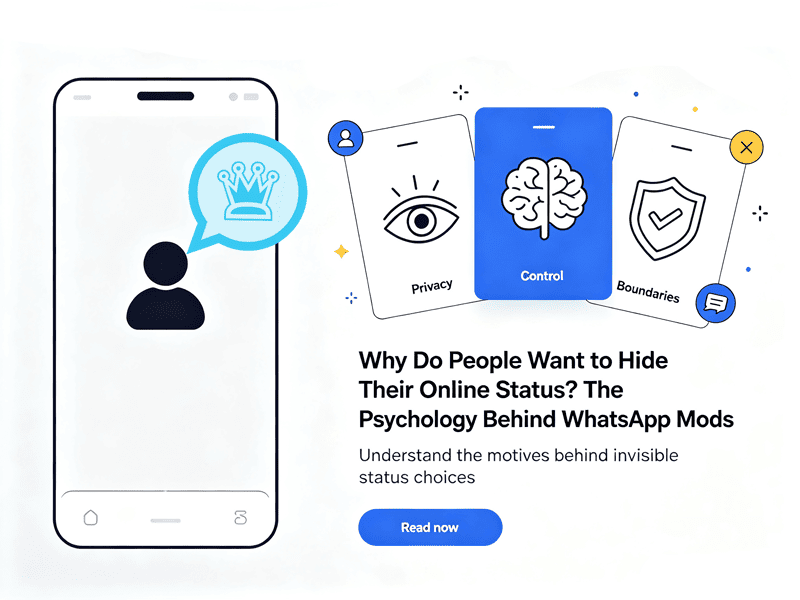
The Psychology of WhatsApp Online Status Privacy: Four Core Drivers
To truly understand why people hide their online status, we need to look beneath the surface. Here are four psychological drivers that explain this behavior:
1. Control Over Availability
People naturally want to feel in control of their own lives. When you feel pressured to reply to messages immediately, you lose that sense of freedom. Turning off your online status helps you regain control. It allows you to decide when you want to talk to others, without the pressure of a green light showing you are active. This is very helpful for people with stressful jobs or those caring for others who cannot always stop what they are doing to chat.
2. Fear of Missing Out Reversed
Strangely, the fear of missing out (FOMO) makes people both check their messages and hide their online status. Some users hide so others don’t feel ignored when they don’t reply right away. Others stay invisible so they don’t have to see their friends having fun without them. By hiding, they avoid the bad feelings that come from knowing what they are missing.
3. Social Comparison and Self-Presentation
Always seeing friends online can make you feel jealous or like you aren’t doing enough. On the flip side, if you are always seen as “available,” people might think you have nothing else to do. Hiding your status lets you manage how you appear to others. You can choose to look busy or mysterious to match the image you want to project.
4. Boundary Setting in a Hyperconnected World
The most important reason to set boundaries is for your health. Since work emails and group chats are constant, taking time away from your screen is necessary for your peace of mind. Hiding your online status is a simple but effective way to practice self-care. It shows that while you are present, you aren’t always available to talk.
My Take: Privacy Is Not the Same as Secrecy
Personally, I think the biggest misunderstanding surrounding hidden online status is the idea that people who use it must be hiding something.
That assumption is too simple.
People need personal space even when they are using social apps. Being online does not mean being emotionally ready for a conversation. Reading a message does not mean having enough time to write a thoughtful answer. Opening WhatsApp does not mean agreeing to talk to everyone.
For me, the healthiest way to think about WhatsApp online status privacy is as a boundary. It allows users to decide when they want to be visible and when they want to be left alone.
The question of why people hide online status is ultimately much bigger than one WhatsApp setting. Wanting to hide your online status can simply mean that you want more control over your time.