Modified WhatsApp apps are unofficial versions of WhatsApp that add features or change parts of the standard messaging experience. Names such as Blue WhatsApp, WhatsApp Plus, and other modified versions have become familiar in different online communities.
But why do these apps attract more attention in certain regions? Why does one country have a strong community around modified WhatsApp apps while users somewhere else are perfectly happy with the official application?
WhatsApp Mods by Country: Where Popularity Is Concentrated
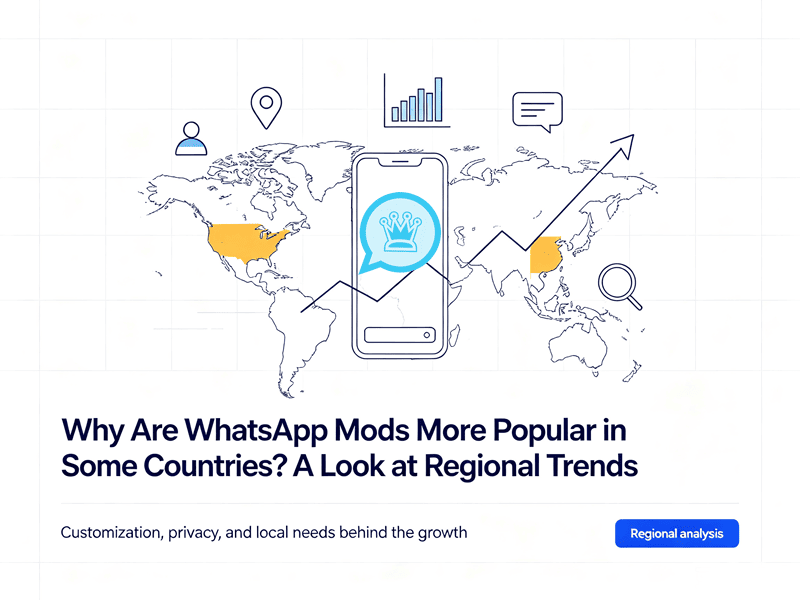
There is no single reliable global database that counts every person using an unofficial WhatsApp modification. The table below synthesizes app-usage panel studies, APK tracker download shares, search interest, and field reports to give a directional picture of WhatsApp mods popularity by country.
| Region | Leading markets | Relative mod intensity | Dominant trigger |
| South Asia | India, Pakistan, Bangladesh | Very high | Dual-account demand, privacy, cheap Android base |
| Sub-Saharan Africa | Nigeria, Kenya, Ghana, South Africa | Very high | Privacy controls, data-light sharing, peer distribution |
| MENA | Egypt, Iraq, Morocco, Jordan | High | Customization, large-group and business use |
| Southeast Asia | Indonesia, Malaysia, Philippines | Moderate–high | Small-business multi-number management |
| Latin America | Brazil, Mexico, Colombia, Argentina | Moderate | Business use, but stronger iOS presence |
| Western Europe & North America | Germany, UK, US, Italy, Spain | Low | iOS share, Play Store trust, regulatory caution |
| East Asia | China, Japan, South Korea | Negligible | WhatsApp itself is not the default messenger |
South Asia: the single largest pool of WhatsApp mod users
WhatsApp is a major part of daily life, used by almost everyone for both personal and work purposes. People rely on it for everything from family and school groups to business communications.
One reason WhatsApp mod popularity by country can vary here is the huge diversity of users.
Some people want a simple app that works right away without any changes. Others enjoy customizing their phones with different themes and software. For those who like to personalize their experience, a modified WhatsApp is an appealing way to change how a familiar app looks and functions.
Crucially, distribution is offline-first. Users pass the APK between devices using peer-to-peer file-sharing tools or download it from a local website — bypassing app stores entirely.
The Middle East and North Africa: customization and the rise of Blue WhatsApp popularity
In MENA markets, the draw skews toward visual customization and group management. Blue WhatsApp popularity — like that of Fouad WhatsApp and YoWhatsApp — is tightly linked to theme stores and UI personalization, which carry real social currency among younger users who treat their messenger interface as an identity signal.
Latin America and Europe: high WhatsApp usage, low mod usage
Almost everyone in Brazil uses WhatsApp—about 148 million people—but very few use modified versions of the app. This isn’t because they don’t care about privacy; it’s because of the types of phones they use and who they trust. In major Latin American cities, more people use iPhones, prefer downloading apps from official stores, and pay attention to security warnings, all of which discourage using unofficial software. Similarly, in Western Europe, strict data privacy laws and a general distrust of unverified apps keep people using the official version of WhatsApp.
Key Drivers Behind Regional WhatsApp Mods Popularity
1. Android dominance and a mature APK culture
The first requirement is simple: WhatsApp needs to be important in the region. If almost everyone a person knows uses WhatsApp, there is a strong reason to look for ways to improve or personalize it. A modification of an unpopular app would have little value because the user’s contacts would not be there.
This is why high regional WhatsApp usage creates the foundation for mod communities.
2. High Data Costs and Offline Sharing
In many African countries, mobile data is relatively expensive compared to average income levels. Standard app downloads via official storefronts like the Google Play Store devour precious data.
- Offline Sharing: In countries such as Nigeria, Kenya, and South Africa, people often use apps like Xender or SHAREit to send files directly from one phone to another without using the internet. They frequently share modified versions of WhatsApp this way to avoid using mobile data for downloads.
- Large File Transfers: While the standard WhatsApp app limits the size of videos and audio files you can send, modified versions allow for much larger files. This makes them very useful for sharing media in areas where high-speed internet is hard to find.
3. Zero-Rating and App Dominance
In countries like Brazil, Mexico, and India, WhatsApp functions essentially as the default internet ecosystem.
- Free Data Packages: Many phone companies offer plans where using WhatsApp and Facebook doesn’t cost any data. Because the rest of the internet is expensive while these apps are free, many people use them for all their online activities.
- Business Use: Small business owners rely heavily on WhatsApp to run their shops. They often use modified versions of the app to manage two different accounts on one phone, which helps them keep their personal life and work messages separate on affordable devices.
4. Device Performance and Operating System Variety
While Apple is the leader in North America, Android is the primary choice in the Global South. In regions like Africa and Latin America, Android accounts for roughly 80% to 85% of the market.
- The Sideloading Habit: Android’s open design makes it very simple for users to download and install apps directly from websites. This open system has made it easier for local developers to create and share modified apps throughout these areas.
WhatsApp Mod Trends Change Over Time
It is also important not to think of WhatsApp mod popularity as something fixed.
The popularity of individual mods can change rapidly.
One version may become popular because it offers a new privacy feature. Another may attract attention because of its interface. A third may become popular because it receives frequent updates.
Then the situation can change.
WhatsApp itself regularly introduces new features. When the official application adds something that users previously needed a mod to obtain, the reason for using that particular mod becomes weaker.
For example, if users wanted a privacy setting that was missing from the official application and WhatsApp later introduced a similar option, some users may decide there is no longer a reason to use an unofficial version.
This creates a constant competition between official WhatsApp updates and modified applications.
Mods need to offer something different to remain interesting.
What the Future May Look Like for WhatsApp Mod Trends
The future of WhatsApp mod trends will probably depend on how quickly official WhatsApp responds to user expectations.
If WhatsApp continues adding customization and privacy features, some reasons for using mods will become less important. At the same time, modified apps will likely continue to attract people who want more control than the official application provides.
The Android ecosystem also makes experimentation relatively accessible. As long as users remain interested in customizing their apps, there will probably be a market for unofficial alternatives. However, the technical gap may become smaller over time.
Since the official WhatsApp app is already adding many features that used to be exclusive to mods, modified apps will likely have to focus on very specific, niche tools to stay relevant.